
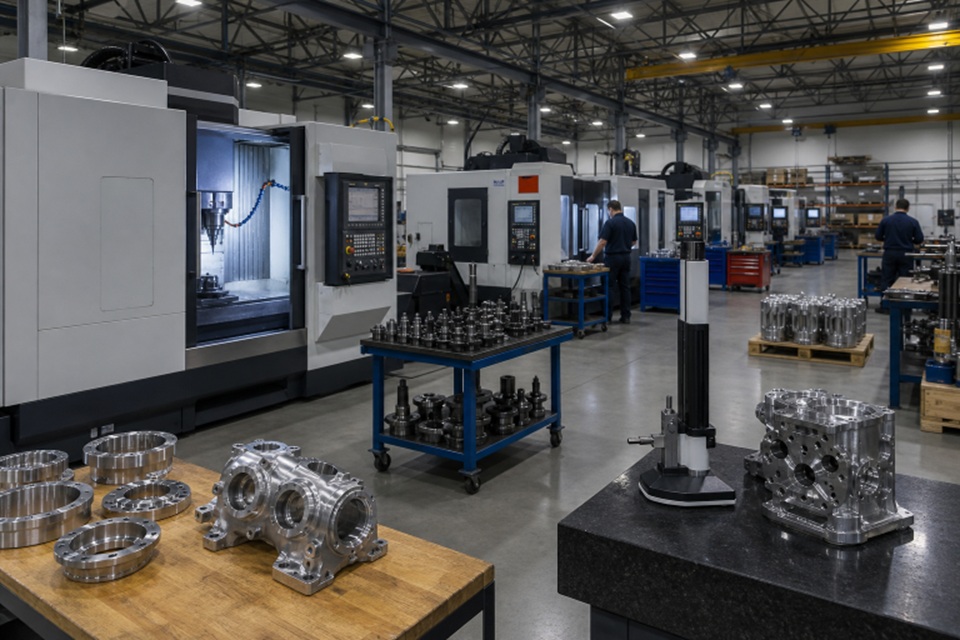
Choosing a manufacturing process is not simply a matter of finding the fastest CNC machine. For complex parts, the real question is whether the process can hold the required geometry, tolerance, finish, and repeatability at the planned production volume. A compact medical fitting, for example, may combine a critical bore, fine threads, tight sealing surfaces, and material that is difficult to machine. A multi-feature automotive shaft can create similar challenges at much higher volumes.
That is where specialty machining centers can become relevant. M. K. Chambers Company, a North Branch, Michigan manufacturer, explains how these capabilities support demanding automotive, aerospace, medical, defense, energy, and industrial applications. Its experience with high-volume, complex components, including CNC machining, thread rolling, broaching, assembly, and secondary operations, makes it a useful example of why the right production route should fit the part rather than forcing the part to fit a single machine.
Table of Contents
What Makes A Part Complex?
Complexity is not limited to unusual shapes. A part may look straightforward on a drawing, but still be difficult to manufacture consistently. Complexity usually appears when several features must remain precisely related after machining, finishing, heat treatment, or assembly.
- Multiple datum relationships that must remain aligned.
- Compound angles, deep cavities, or limited tool access.
- Thin walls, long, narrow profiles, or features prone to deflection.
- Controlled bores, fine threads, sealing surfaces, or tight fits.
- Hardened steel, titanium, nickel alloys, or other demanding materials.
- Features requiring machining from several directions.
When Standard CNC Machining Still Works
Standard three-axis CNC machining remains an excellent choice for many jobs. It is often the most practical route for prismatic parts with open pockets, standard holes, accessible faces, moderate tolerances, and stable production volumes. A simpler process can reduce programming time, fixture cost, inspection burden, and lead time.
The goal is not to add complexity for its own sake. Tight tolerances should be reserved for dimensions that affect function, fit, safety, sealing, motion, or performance. Applying demanding requirements to every feature can increase cost without improving the finished product.
Signs A Specialized Process May Be A Better Fit
A different production route is worth considering when repeated setups create location errors, multiple operations must remain concentric, or a part needs turning, milling, broaching, threading, and finishing in a coordinated sequence. Specialty does not necessarily mean exotic. It often means selecting equipment, workholding, tooling, and inspection methods around a specific production problem.
- Manual handling increases scrap, rework, or inspection time.
- Tool access is restricted by the part shape.
- Several finished features must stay aligned.
- Annual volume requires reliable cycle times and repeatability.
- Secondary operations are becoming a bottleneck.
Industry Needs Shape Process Decisions
Automotive, Aerospace, & Medical
Automotive suppliers often need repeatable shafts, fasteners, steering components, gears, and powertrain parts at scale. Aerospace work may involve complex geometry, difficult alloys, strict traceability, and little tolerance for defects. Medical-device components can require small dimensions, clean finishes, controlled fits, and documented procedures because minor variation may affect device performance.
Defense, Industrial, Energy, & Heavy Equipment
Defense programs can demand secure sourcing, durable materials, consistent repeat orders, and clear production records. Industrial equipment often combines housings, couplings, drive parts, and fluid-control components that need several secondary operations. Energy and heavy-equipment parts must frequently withstand vibration, heat, load, corrosion, or harsh operating environments, making material selection and finishing just as important as machining.
Match Features To The Method
- Complex angled surfaces: Multi-axis milling or indexed machining can improve access and reduce refixturing.
- Long, narrow turned parts: Swiss-style or supported turning helps control deflection.
- Fine internal features: Specialized boring, tooling, or EDM may be appropriate.
- Hardened bearing surfaces: Grinding or a dedicated finishing operation may be required.
- Grooves, splines, and formed profiles: Broaching, shaping, spline rolling, or gear-specific processes can provide better consistency.
- High-volume threaded parts: Thread rolling or thread-forming processes may improve strength and throughput.
- Parts with many finished features: Use a coordinated plan that considers machining, heat treatment, coating, assembly, and final inspection together.
Why Fewer Setups Can Improve Quality
Every additional setup creates another opportunity for movement, clamping variation, datum loss, or measurement error. Completing more features in one controlled setup can improve positional relationships and shorten handling time. Still, fewer setups are not an automatic guarantee of quality. Fixture stability, tool selection, programming, coolant control, and inspection discipline remain essential.
Modern process control increasingly uses in-process probing, machine monitoring, and thermal compensation to identify variation before it becomes scrap. Research from NIST machining programs highlights the practical value of integrated measurement and real-time process monitoring for improving yield and controlling machine-tool behavior.
Quality Control Must Start Before Final Inspection
Final inspection can identify a bad part, but it may not explain why the process drifted. Strong production plans use first-piece approval, in-process probing, tool-wear checks, coordinate measuring machines, surface-finish testing, and documented process checks. Temperature changes, material variation, worn tools, and unstable workholding can all influence results. Quality data is most valuable when it allows a correction before an entire batch is complete.
How To Evaluate A Manufacturing Partner
- Review experience with similar materials, geometries, and part families.
- Ask which operations are performed in-house and which are outsourced.
- Confirm machine capacity, work envelopes, production volumes, and inspection capability.
- Ask how design-for-manufacturing feedback is handled before production release.
- Compare total cost, including setup, finishing, freight, inspection, and rework risk.
- Confirm support for prototypes, pilot runs, capability studies, and future repeat orders.
Questions To Resolve Before Production
Identify which dimensions are truly critical, whether tolerances apply before or after coating and heat treatment, and whether the design can improve tool access or reduce setups. Also, define the annual volume, cleaning, marking, assembly, packaging, and shipment documentation requirements early. Common mistakes include choosing only by quoted piece price, tolerancing every dimension tightly, ignoring finishing allowances, and waiting until production begins to discuss inspection records.
Choose The Process That Fits The Part
Standard CNC machining remains highly effective for the right work. Specialty methods become valuable when geometry, material, volume, tolerance, or secondary operations create additional risk. The strongest decision evaluates the full process from design review through delivery. The best machine is not always the most advanced one. It is the process that reliably produces the required part at a sensible cost, with quality controls and scalable capacity.





No Comments